
Want SoilTestsLab to perform your Resistivity Testing? Contact us now for pricing. We have engineers available nationwide.
The Wenner 4-pin method (ASTM G57), also known as the Wenner method, is a widely used technique for measuring the electrical resistivity of materials, particularly soils and subsurface layers. Wenner 4-pin testing is primarily used to measure the resistivity of the ground, which is the material’s ability to resist the flow of electrical current. The electrical resistivity of soils and rock formations can vary based on the material's moisture content, temperature, and composition, making this test particularly useful in different fields such as:
Soil characterization
Site suitability for grounding systems
Locating subsurface features (groundwater)
Soil Corrosivity
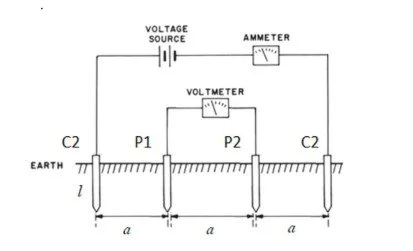
The Wenner method measures resistivity by placing four electrodes in a straight line on the ground surface. By inducing current into the ground through two outer electrodes and measuring the voltage difference between two inner electrodes, the resistivity of the subsurface can be inferred.
SoilTestsLab follows ASTM G57 and uses equipment compliant with IEEE 81. Your report will also come stamped by a registered professional Civil Engineer.
What is Soil Resistivity Testing (Wenner 4 Pin Testing)?
Reliable Wenner 4-Point Soil Resistivity Testing — Fast, Accurate, and ASTM G57 Compliant
Get Your Grounding Project Moving — Without Delays
If your project requires a soil resistivity test for grounding or cathodic protection design, you need a lab that understands ASTM G57 and IEEE 81 standards and delivers reliable data fast.
At Soil Tests Laboratory, we perform Wenner 4-point resistivity testing for engineering firms, utilities, and contractors across the country.
We know these tests often hold up electrical design submittals or grounding layouts — so our process is built for speed, accuracy, and documentation that passes review the first time.
Why Choose Soil Tests Laboratory
✅ Same-week scheduling — We mobilize quickly anywhere in the nation.
✅ Licensed PE oversight — All reports reviewed and signed by professional engineers.
✅ ASTM G57 / IEEE 81 compliant — Industry-standard Wenner 4-pin testing with full data tables and depth profiles.
✅ Multi-depth readings — We capture subsurface variability that generic testers miss.
✅ Detailed reporting — Includes ohm-meter resistivity values, plots, and design recommendations.
✅ Clear deliverables — Reports formatted for direct inclusion in grounding and cathodic protection design packages.
Trusted by Contractors and Engineers
Our clients include:
Utility and power transmission companies validating substation grounding grids
Electrical and civil contractors preparing compliance packages
Corrosion engineers designing CP systems for pipelines and tanks
Telecom and solar developers meeting grounding design submittal requirements
We specialize in field testing and reporting that clears utility or AHJ review — no wasted time, no incomplete data.
How It Works
We quote fast. Provide the project location, required depths, and number of test sites — we’ll issue a firm quote within 24 hours.
We mobilize quickly. Field crews arrive with calibrated Wenner test equipment, ground stakes, and 12-V source.
We deliver usable results. Reports typically turned around in 2–3 days, stamped by a licensed PE if needed.
Contact Us
Get your soil resistivity testing done right the first time.
📞 Call Soil Tests Laboratory or request a quote online.
When the Design Depends on Accurate Data, Rely on Us
Whether you’re finalizing a grounding system design or completing cathodic protection calculations, everything starts with one number: soil resistivity.
At Soil Tests Laboratory, we specialize in ground resistivity testing using the Wenner 4-pin method — the gold standard for accurate, reproducible results.
Why Engineers and Contractors Use Us
We’re not just a testing lab — we’re engineers who understand how your data will be used.
We provide interpretation and design input, not just raw readings.
We understand utility review standards and prepare reports that get accepted.
We can combine resistivity with pH, chloride, sulfate, and redox testing for full soil corrosivity profiles.
Our results are trusted for:
Substation and transmission grounding design
Pipeline CP system design
Telecom tower grounding
Solar farm installations
Industrial facility upgrades
Deliverables You Can Plug Straight Into Design
Each report includes:
Field data tables (spacing vs. resistance)
Apparent resistivity calculations (Ω·m)
Depth-dependent resistivity plots
Soil profile interpretation and recommendations
Optional PE stamp for permit submittals
This isn’t a generic test report — it’s an engineering deliverable, ready to drop into your project submittal package.
Fast Turnaround, Competitive Pricing
We understand your schedule. That’s why our clients choose us for:
Rapid mobilization across the country.
Flat-rate pricing per site with no hidden mobilization fees
2-day average turnaround time on digital reports
We also offer bundle pricing when resistivity testing is combined with soil corrosivity or percolation testing at the same site.
Let’s Get Your Project Moving
Need ground resistivity testing for your design?
Get a quote today — we’ll handle the testing, data reduction, and reporting so you can move forward with confidence.
📞 Call Soil Tests Laboratory or visit SoilTestsLab.com to schedule service.